
Rohit Sharma Padma Shri Award: There were no roaring crowds, no floodlights piercing the night sky, and no scoreboard demanding attention. Yet for Rohit Sharma, June 23 carried the weight of every century, every captaincy decision, every triumph and heartbreak that has shaped one of Indian cricket’s defining careers.
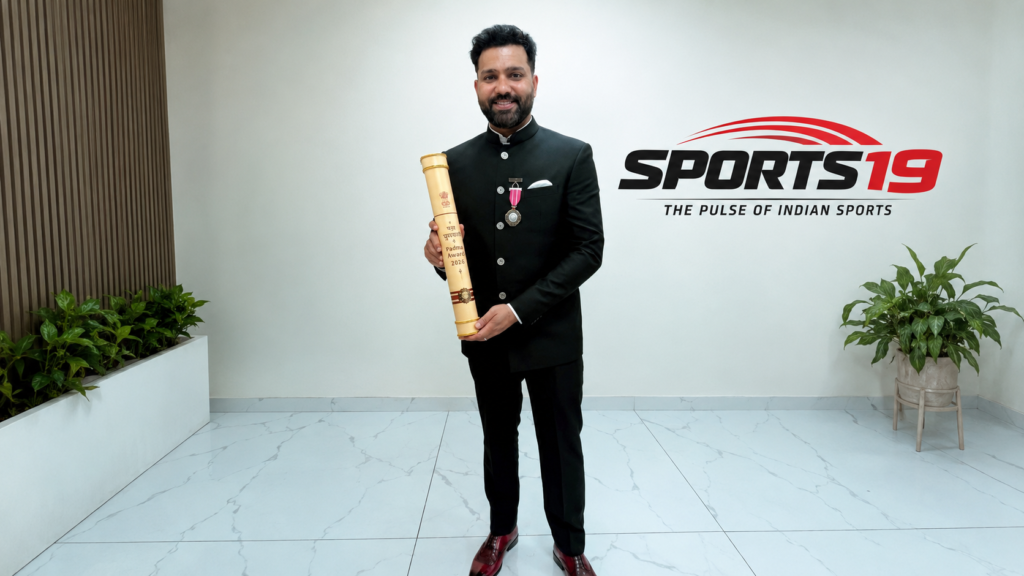
Standing proudly in a black bandhgala, the Indian captain held the Padma Shri citation in his hands and smiled for the camera. It was a quiet image, but it spoke volumes. Nineteen years after a young Mumbai batter first pulled on the India cap, the nation had formally placed him among its most celebrated sporting icons.
For millions of cricket fans, it felt less like an award ceremony and more like the culmination of a story they had watched unfold ball by ball.
Rohit himself summed it up perfectly in a heartfelt social media post.
“19 years ago, it began with an India cap. Today, another proud chapter is added to the story.”
Those words carried the emotion of a player who has spent nearly two decades carrying expectations that few athletes could survive.
The journey has never been as straightforward as the statistics might suggest.
Also Read: Ellyse Perry Stars as Australia Crush Pakistan by 113 Runs
When Rohit burst onto the international scene in 2007, talent was never the question. The debate was always about consistency. Teammates spoke about his timing in awe. Opponents feared the ease with which he could dominate bowling attacks. Yet for years, cricket followers wondered when that immense potential would fully translate into greatness.
The answer arrived when he reinvented himself. Promoted to open the batting in limited-overs cricket, Rohit transformed not only his own career but also India’s approach at the top of the order. Suddenly, innings that began cautiously turned into spectacles. Bowlers who survived the opening spell often found themselves powerless once Rohit settled into rhythm.
His three ODI double centuries remain among the most extraordinary achievements in cricket history. The 264 against Sri Lanka still feels almost unreal, a number that looks more like a video game score than an international innings.
But the true turning point of Rohit’s career came when leadership responsibilities landed on his shoulders.
Captaining India is unlike leading any other sporting team in the country. Every decision is dissected. Every defeat becomes a national debate. Every success brings a fresh wave of expectations.
Rohit embraced that pressure.
Under his leadership, India became one of the most feared white-ball teams in world cricket. His calm presence stood in stark contrast to the chaos often surrounding modern cricket. While others reacted emotionally, Rohit trusted plans, trusted players, and trusted the process.
Those qualities became especially evident during major tournaments, where tactical flexibility often separated champions from contenders.
His captaincy style rarely demanded headlines. Instead, it produced results.
Field placements arrived seconds before crucial deliveries. Bowling changes disrupted partnerships. Younger players found confidence because their captain publicly backed them during difficult moments.
“He makes the game look simple,” has become one of the most common observations from teammates and analysts alike.
That simplicity, however, masks years of preparation and cricket intelligence.
What makes the Padma Shri particularly significant is that it recognizes more than runs and trophies. It acknowledges influence.
Across India, young cricketers copied Rohit’s pull shot. Coaches showed videos of his balance at the crease. Aspiring captains studied the composure he displayed during pressure situations.
Few players have managed to inspire multiple generations simultaneously.
The reaction from fans reflected that reality.
Also Read: Ronaldo Double Inspires Portugal’s Five-Star Rout
Social media quickly filled with congratulatory messages. Former cricketers, teammates, and supporters celebrated a recognition many believed was long overdue. The photographs of Rohit receiving the honour spread rapidly, triggering memories of iconic innings, match-winning knocks, and unforgettable captaincy moments.
For supporters who have followed his journey from the beginning, the award felt deeply personal.
They remembered the teenager from Mumbai carrying enormous promise.
They remembered the elegant stroke-maker finding consistency.
They remembered the opener rewriting record books.
And they remembered the captain guiding Indian cricket through some of its most important years.
Every phase of that evolution seemed present in a single frame as Rohit stood holding the Padma Shri citation.
The honour also arrives at a moment when Indian cricket is entering a new era. Senior players increasingly find themselves balancing legacy with the future of the game. Awards such as the Padma Shri serve as reminders that careers are measured not only by victories but by the lasting impact left behind.
Rohit’s legacy already extends far beyond numbers.
It lives in packed stadiums that rose to applaud his hundreds. It lives in dressing rooms where younger cricketers learned from his example. And it lives in the millions of fans who grew up watching him turn difficult situations into unforgettable performances.
As the cameras clicked and the celebrations continued, the moment carried a sense of completion.
Not an ending—far from it—but a milestone.
Nineteen years after an India cap first changed his life, the nation responded with one of its highest civilian honours. For Rohit Sharma, the boy who dreamed of representing India, the journey has come full circle.
And somewhere in that quiet smile was the unmistakable look of a man who understood exactly what the moment meant—not just for himself, but for everyone who had travelled the road with him.
Also Read: Chamari Athapaththu Century Keeps Sri Lanka Alive