

From rural sporting grounds to international competitions, sports analyst and athletics official Pisini Satti Babu shares his perspective on India’s Olympic ambitions, cricket’s commercial dominance, grassroots development and the future of Indian sports in an exclusive conversation with Sports19.
India is a nation with immense sporting potential. Its population, young talent and growing enthusiasm for competitive sports provide the foundation for becoming a global sporting powerhouse. Yet, despite producing exceptional athletes across multiple disciplines, the country continues to face significant challenges in translating its potential into consistent international success.
Behind every international medal is a journey that often begins far away from the spotlight. For many aspiring athletes, that journey starts in villages, school playgrounds and local sporting competitions, where opportunities, facilities and professional guidance can determine how far their talent progresses.
For Pisini Satti Babu, an experienced sports analyst, cricket commentator and athletics official, the challenges facing Indian sports begin at precisely this level.
With an academic background in physical education and experience spanning competitive athletics, cricket, kabaddi, sports commentary, umpiring and mountaineering, Satti Babu has developed a perspective that extends beyond individual sporting performances.
In an exclusive interaction with Sports19, he shared his observations on the structural challenges affecting Indian sports, the growing commercialisation of cricket, the importance of professional coaching and the need to create better opportunities for emerging athletes.
The journey began on the village playground
Satti Babu’s connection with sports developed naturally during his childhood in a rural environment. What began as an ordinary childhood interest gradually became a deeper passion as he grew older.
The influence of senior students, radio commentary and television coverage played important roles in shaping his sporting interests.
His journey eventually extended beyond participation, taking him into sports analysis, commentary and officiating.
His educational qualifications include a Master’s degree in Physical Education (M.P.Ed.), along with B.A. and B.P.Ed. degrees. He also participated in All India Inter-University Athletics Championships and represented Andhra Pradesh in state athletics competitions on 15 occasions, according to his professional résumé.
India’s Olympic ambitions need stronger foundations
One of the most significant issues highlighted by Satti Babu is the absence of a sufficiently developed grassroots sporting system.
He believes India cannot consistently produce international champions without identifying talented children at an early age and providing them with structured opportunities.
The shortage of qualified physical education teachers in schools, inadequate training facilities, limited sports academies and a lack of specialised coaches are among the concerns he identifies.
He also expressed concern about insufficient financial investment in several sporting disciplines and the possibility of political interference affecting selection processes.
According to his assessment, talented youngsters from rural backgrounds often struggle to progress because they do not receive the same access to professional training and infrastructure as athletes in better-equipped sporting centres.
Drawing attention to the extraordinary achievements of American swimming legend Michael Phelps, Satti Babu emphasised the scale of international sporting excellence India must aspire to reach.
His argument is not that Indian athletes lack ability, but that the sporting ecosystem must do more to nurture that ability.
How cricket became India’s commercial sporting giant
Cricket’s extraordinary popularity in India is another subject on which Satti Babu offered an interesting perspective.
He believes television exposure played a major role in establishing cricket’s dominance.
While several other sporting disciplines struggled to receive consistent live broadcasting coverage during earlier years, cricket gradually became a familiar presence in Indian households.
That visibility helped build a massive audience, which eventually attracted commercial investment, sponsorships and greater media attention.
The financial strength of the Board of Control for Cricket in India further reflects how successfully cricket has developed as a commercial sporting industry.
Satti Babu believes governments and institutions are naturally attracted to sports that generate substantial revenue and public attention. However, he argues that other disciplines deserve greater recognition and support regardless of their commercial value.
Also Read: FROM CAPTAIN COOL TO THE MASTER MENTOR!
IPL: A platform for emerging cricketers, but not without concerns
The introduction of the Indian Premier League in 2008 transformed the professional landscape of Indian cricket.
For Satti Babu, one of the tournament’s most important contributions has been the opportunities it creates for players from smaller towns and rural backgrounds.
The IPL gives emerging cricketers a platform to demonstrate their abilities, earn financial rewards and attract attention from professional franchises.
He cited players including Mohammed Siraj, Tilak Varma, T. Natarajan, Vinay Kumar, Umran Malik and Nitish Kumar Reddy while discussing the opportunities available through the IPL ecosystem.
He believes the competitive franchise structure encourages players to improve their performances and creates additional pathways towards national recognition.
However, his assessment of cricket’s commercial expansion also includes a serious warning.
Satti Babu expressed concern about the growing influence of cricket betting, particularly in smaller towns and rural communities. He believes betting-related financial losses can have devastating consequences for individuals and their families.
For him, the IPL represents both opportunity and responsibility. While professional leagues can transform sporting careers, their negative social consequences must not be overlooked.
Kabaddi’s growing popularity offers hope for traditional sports
Cricket is not the only discipline benefiting from professional sporting leagues.
Kabaddi, which has traditionally been popular in Indian villages, has gained significant visibility through televised professional competitions.
Satti Babu believes the Pro Kabaddi League has helped introduce the sport to a much wider audience.
He considers kabaddi an important part of India’s sporting culture and believes professional platforms can help traditional disciplines attract younger generations.
Its growing popularity also demonstrates that Indian sports need not depend exclusively on cricket to build commercial success and public interest.
The grassroots selection system needs transparency
For Satti Babu, identifying talent is only one part of sporting development. Ensuring that deserving athletes receive opportunities is equally important.
He believes selection procedures must remain transparent at every level, from village competitions to district and state championships.
Political interference and favouritism, in his view, can undermine the confidence of aspiring athletes.
He also highlighted the shortage of adequate infrastructure and qualified coaching personnel in several district-level sporting institutions.
Without suitable facilities, professional guidance and consistent competitive opportunities, even talented athletes may struggle to reach their potential.
The importance of professional coaching
India’s achievements in international badminton, athletics and other disciplines demonstrate the value of specialised training.
Satti Babu highlighted the contributions of athletes such as P. V. Sindhu, Saina Nehwal, Karnam Malleswari, Leander Paes, Neeraj Chopra and Achanta Sharath Kamal.
He believes professional coaching, parental encouragement and access to specialised facilities have played important roles in developing successful athletes.
He also noted that some Indian athletes have benefited from international training opportunities.
Badminton, in particular, requires access to indoor courts, specialised equipment and professional coaching. These requirements can create financial barriers for aspiring players, especially those from rural and economically disadvantaged backgrounds.
His observations point towards a larger issue: quality sporting education and coaching should not become privileges available only to families that can afford expensive private training.
Also Read: The Rise of India in Olympics
Why different regions produce different sporting strengths
India’s sporting landscape is shaped by regional cultures, institutional support and access to opportunities.
The northeastern states have developed strong traditions in disciplines such as football and boxing. Kerala and Tamil Nadu have contributed significantly to athletics, while Haryana has established a strong reputation in wrestling.
Satti Babu attributes these regional sporting strengths to a combination of local sporting culture, government encouragement, educational awareness and opportunities for participation.
He believes that consistent support and an environment that encourages young people to pursue sports are essential for developing successful athletes.
He also raised concerns about the challenges facing Indian archery, particularly the need for specialised coaches, stronger athlete support systems and better preparation for international competition.
Commonwealth success and the Olympic challenge
Success at the Commonwealth Games does not automatically translate into Olympic medals.
Satti Babu believes the difference lies in the competitive environment and the level of preparation required.
The Commonwealth Games feature participating nations associated with the Commonwealth, whereas the Olympic Games bring together competitors from across the world.
For Indian athletes, the Olympics represent an opportunity to measure themselves against the strongest international competition.
He believes the country must focus on long-term preparation, specialised coaching and consistent international exposure rather than judging sporting progress through individual tournaments.
Inspired by India’s sporting legends
Satti Babu’s admiration for Indian sporting history extends across multiple disciplines.
He identifies P. T. Usha, Milkha Singh, Major Dhyan Chand, Sunil Gavaskar and Virender Sehwag among the sporting personalities who have inspired him.
Their achievements represent different generations of Indian sporting excellence, from athletics and hockey to international cricket.
His own professional experiences have also brought him into sporting environments alongside prominent personalities.
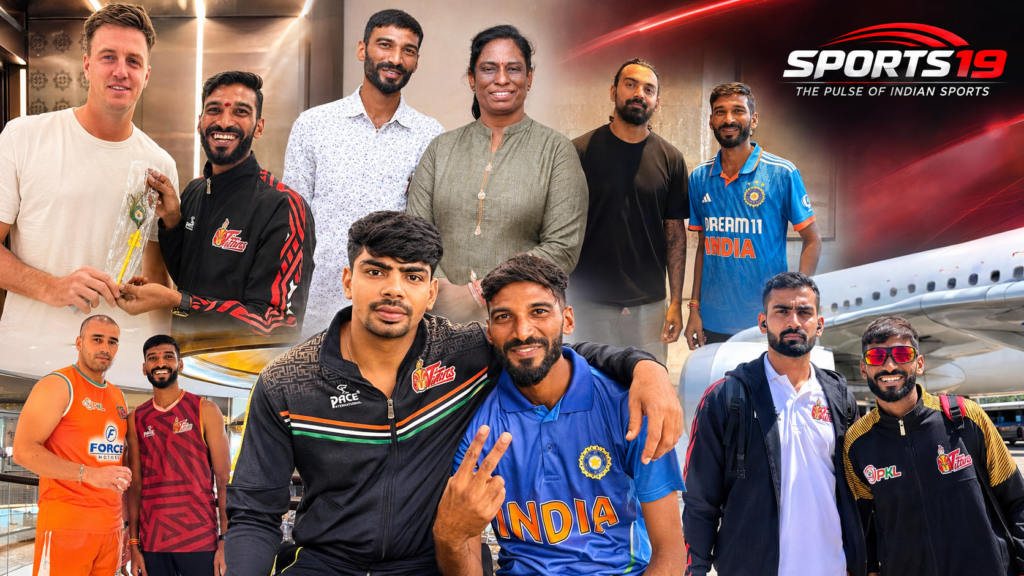
Photographs shared with Sports19 document memorable moments with P. T. Usha, P. V. Sindhu, Saina Nehwal, Morne Morkel, KL Rahul and several kabaddi personalities, including Pavan Kumar and Bharat Hooda.
These photographs offer a glimpse into his association with the wider sporting world.
A sporting career beyond the playing field
Satti Babu’s professional journey extends across several areas of sports.
His competitive experience includes All India Inter-University Athletics Championships during 2012–13, 2013–14 and 2015–16.
He participated in 20-kilometre race walking events at Punjab University, Patiala, and Mangalore University. His résumé also records participation in a 21-kilometre half-marathon at Punjab University.
Beyond athletics, he represented Dr. B. R. Ambedkar University in cricket and participated in district-level kabaddi and kho-kho competitions.
His involvement in sports also includes adventure activities. After completing a basic mountaineering course at the Himalayan Mountaineering Institute in Darjeeling, he participated in Himalayan mountaineering expeditions, including an expedition to Mount Rinak in Sikkim and a winter expedition camp in Pahalgam, Jammu and Kashmir.
His professional experience includes sports analysis for television channels covering major cricket tournaments, including the 2022 T20 World Cup, 2023 ODI World Cup and 2024 T20 World Cup.
He has also worked as a cricket commentator for regional tournaments, including the YSR Cup, Palasa Premier League and university-level competitions.
His officiating experience extends to cricket umpiring at district and village levels, along with athletics competitions ranging from district and state events to junior national and inter-university competitions.
His message to India’s next generation
For young athletes hoping to build careers in sports, Satti Babu’s message centres on three essential qualities: discipline, patience and consistent practice.
He believes training must be scientifically structured and athletes must remain committed even when immediate results are difficult to achieve.
He also expressed concern about the increasing dependence on mobile phones and substance abuse among younger generations.
According to him, more youngsters need to return to playgrounds and physical activities instead of becoming disconnected from outdoor sports.
With India’s large young population, he believes the country has an enormous opportunity to strengthen its sporting future. However, that potential can only be realised if families, educational institutions, sporting organisations and governments work together.
The road ahead
India’s sporting future will not be determined by cricket alone, nor will it be built exclusively through a handful of international champions.
The real transformation must begin in schools, villages and district-level sporting institutions.
Better infrastructure, transparent selections, accessible coaching and sustained financial support can create an environment in which talent has a genuine opportunity to flourish.
Pisini Satti Babu’s observations highlight an important reality: India has the potential to become a major sporting nation, but developing that potential requires a stronger foundation.
The next Olympic champion could be growing up in a small village today. The responsibility of the sporting system is to ensure that talent is recognised before opportunity is lost.
For Indian sports to move forward, the journey must begin at the grassroots.
Also Read: INDIA’S INCREDIBLE COMEBACK! India U19 Beat Pakistan in a One-Wicket Classic