

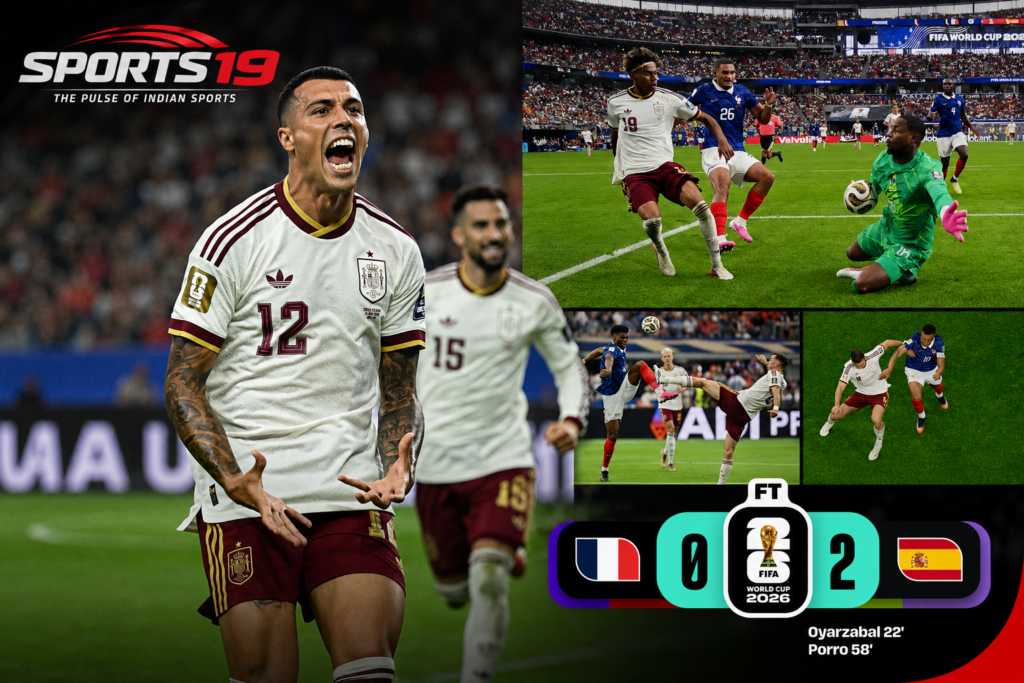
Spain vs France: Spain marched into the FIFA World Cup 2026 final with a composed 2-0 victory over France at Dallas Stadium, delivering a masterclass in efficiency rather than extravagance. On a night when France fired more shots, won more corners and spent long stretches asking questions, it was Spain who provided every meaningful answer. Mikel Oyarzabal’s coolly taken first-half penalty settled early nerves before Pedro Porro’s stunning strike after the break extinguished France’s hopes and sent thousands of Spanish supporters into celebration long before the final whistle.
The scoreboard will show a comfortable win, but the story inside the stadium unfolded with far more tension. France came flying out of the blocks, pressing high, forcing mistakes and repeatedly driving into dangerous positions. Every French attack lifted the crowd from their seats, yet there was one problem that haunted Didier Deschamps’ side all evening—they simply could not find a finishing touch.
Spain, by contrast, looked remarkably calm. They rarely forced the issue, choosing instead to circulate possession patiently and wait for the right moment. Even when France dominated territory, the Spanish players never appeared rushed. That composure proved decisive midway through the opening half.
The breakthrough arrived in the 22nd minute after a rash challenge inside the penalty area handed Spain the perfect opportunity. Oyarzabal walked toward the spot amid whistles from the French end of the stadium, paused briefly, and buried his penalty with complete confidence. The roar from the sea of red and yellow behind the goal echoed around Dallas Stadium, while France suddenly found themselves chasing a match that had been slipping away only moments earlier.
Conceding only sharpened France’s urgency. They attacked with greater intensity, pushed their full-backs higher and began flooding Spain’s defensive third. The chances kept arriving. Attempts flew wide, others were blocked, and several dangerous deliveries flashed across the six-yard box without anyone applying the finishing touch. Spain’s defenders threw themselves into challenges, cleared crosses with authority and forced France into increasingly difficult shooting positions.
Also Read: Cristiano Ronaldo’s Retirement Nears as World Cup Era Ends
If France still believed the equaliser was inevitable, Pedro Porro shattered that belief shortly before the hour mark.
Receiving possession outside the penalty area, the Spanish defender needed only a brief glance before unleashing a thunderous strike that screamed beyond the goalkeeper and into the net. The Spanish bench exploded. Players sprinted toward Porro while supporters erupted in disbelief. It was a goal worthy of deciding a World Cup semi-final—not simply because of its quality, but because it completely shifted the emotional balance of the contest.
At 2-0, France still refused to surrender.
They continued pouring forward, finishing the night with more total attempts than Spain and earning seven corners compared to Spain’s one. Yet every attack met another Spanish intervention. Blocks arrived at crucial moments, interceptions broke promising moves apart, and goalkeeper Unai Simón enjoyed one of those evenings where positioning mattered more than spectacular saves. Spain’s defensive organisation frustrated France until desperation replaced belief.
The defining figure of the evening was not merely Oyarzabal for scoring first or Porro for delivering the knockout punch—it was Spain’s collective discipline. Still, Porro deserves special recognition. Beyond his unforgettable goal, he defended tirelessly against relentless French pressure and embodied Spain’s willingness to balance attacking ambition with defensive responsibility. His performance captured everything this Spanish side has become throughout the tournament: technically gifted, tactically intelligent and emotionally resilient.
Spain’s tactical approach deserves enormous credit. They willingly conceded periods of pressure knowing France would leave spaces during transitions. Rather than chasing possession for its own sake, Spain used it intelligently, completing nearly 500 passes while maintaining their rhythm whenever they regained control. France enjoyed promising attacking spells but too often settled for speculative efforts or found themselves crowded out by compact Spanish defending.
Also Read: They’re Not Soldiers. “They’re Warriors”
The defensive numbers reflected that commitment. Spain produced more successful tackles, more interceptions and several decisive blocks inside dangerous areas. Whenever France threatened to build momentum, another Spanish defender stepped in before genuine panic could develop.
Inside Dallas Stadium, the atmosphere transformed with every passing minute. French supporters attempted to inspire one final comeback, applauding every attack and roaring every corner kick. Across the stadium, Spanish fans responded with songs that grew louder after Porro’s goal. By the closing stages, every completed Spanish pass was greeted with cheers, every clearance celebrated almost like another goal. When the referee finally ended the contest, players collapsed in exhaustion while the Spanish contingent remained on their feet, waving flags and dreaming of one more victory.
For France, the defeat will sting because they created enough opportunities to make this a very different evening. They attacked with intent, matched Spain physically and frequently controlled territory. But football at this level punishes inefficiency, and France paid the highest possible price for failing to convert pressure into goals.
Spain, meanwhile, now stand one victory away from lifting the FIFA World Cup. This semi-final was not built on overwhelming dominance or attacking fireworks. It was built on patience, defensive conviction and ruthless finishing—the qualities that define champions.
Long after the celebrations fade, this night in Dallas will be remembered as the evening Spain proved that controlling a match is not always about controlling every statistic. Sometimes it is about controlling the moments that matter most. Spain did exactly that, and now the road leads only to the World Cup final.
Also Read: India Women Seal Historic 270-Run Test Win Over England